Guide
Write with AI
Drafting with ChatGPT, Gemini or another AI? Give it this prompt first. It tells the AI to answer in exactly the format Handwriter writes best, with tables, maths, flowcharts and space for diagrams, so you can paste the answer straight in.
How to use it
- Copy the prompt below.
- Paste it into a new chat with your AI, along with your question. To use it in every chat, paste it into ChatGPT's Settings → Personalisation → Custom instructions (Gemini: Saved info).
- Copy the answer and paste it into Handwriter.
- Pick a hand, check the preview, download. Where the answer says
[diagram 6], you'll find a box to draw in after printing.
The prompt
Download .txt
I'm going to paste your answers into Handwriter, an app that turns typed text into handwritten pages for my assignments. For every answer in this chat, write in the format below so it comes out right on paper.

FORMAT
1. Plain text only. No bold, no italics, no emojis, no links, no horizontal lines, no code blocks.
2. Headings: start the line with "# ", for example "# Newton's Laws of Motion". Use them for the title and main sections only.
3. Questions: start each question with its number in square brackets, then the question, for example "[Q1] State Newton's first law." Write the answer on the next lines.
4. Lists: "- " for bullet points and "1. " for numbered points, one point per line.
5. Paragraphs: short, 2 to 4 sentences, with one blank line between them.
6. Tables: use pipe tables with a header row and a line of dashes under it. Keep cells to a few words and use at most 4 columns. For example:
| Point | TCP | UDP |
|---|---|---|
| Connection | Connection oriented | Connectionless |
| Speed | Slower | Faster |
7. Maths and science: never use LaTeX or $ signs. Write:
- powers with ^: x^2, m/s^2, 10^-3, e^(-kt)
- subscripts with _: H_2O, x_1, v_(max)
- fractions in curly braces as {top/bottom}: {a/b}, {dy/dx}, {v - u/t}
- square roots as √(...): √(x+1), √(b^2 - 4ac)
- symbols as the characters themselves: × ÷ ± ≤ ≥ ≠ ≈ ° ∞ π θ λ μ Δ Ω α β
- each long equation on a line of its own.
8. Flowcharts: write the whole flowchart on one line like this, steps joined by ->:
[flow: Start -> Read a, b -> Sum = a + b -> Is sum > 10? -> Print sum -> Stop]
Begin with Start and end with Stop, start input and output steps with Read or Print, end a decision step with "?", and keep each step under 5 words. A decision is drawn with Yes carrying on down and No looping back to the step just before it, so put the step to repeat right before the question. No other branches.
9. Diagrams that can't be written as text (labelled figures, circuits, graphs, structures, maps): put [diagram 6] on its own line where the drawing goes, where 6 is how many lines tall it should be (4 to 12). On the next line write "Fig. 1: " and say exactly what to draw and label, so I can draw it after printing.
10. Code: write it plainly with its indentation, lines under 60 characters.

STYLE
- Write like a good student writing by hand: simple words, short sentences, clear points.
- Start straight with the answer. No "Certainly", no "Here is", no closing summary or offers of more help.
- Answer exactly what is asked. If I don't give a length, write about one handwritten page (around 250 words) per question.
- Keep the same spelling style I use.

If my message already contains a question, answer it in this format. Otherwise reply only "Ready." and wait for my question.
What you get
Each kind of answer comes out the way you'd write it by hand:
| Point | TCP | UDP |
|---|---|---|
| Speed | Slower | Faster |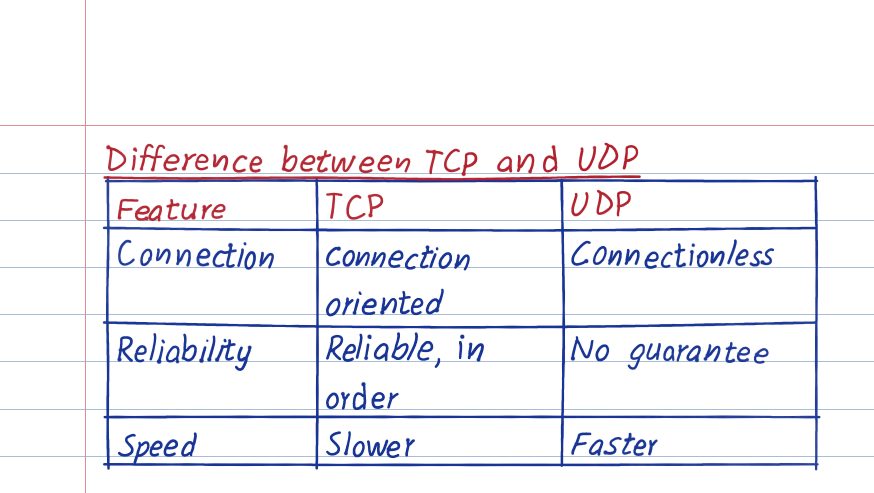
v^2 = u^2 + 2as
Average speed = {total distance/total time}
x = {-b ± √(b^2 - 4ac)/2a}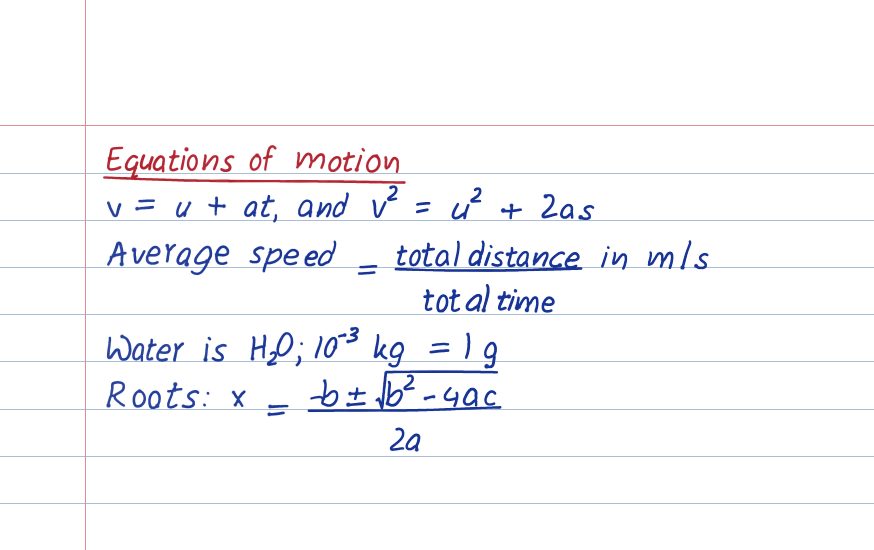
[flow: Start -> Read a, b -> Sum = a + b -> Print sum -> Stop]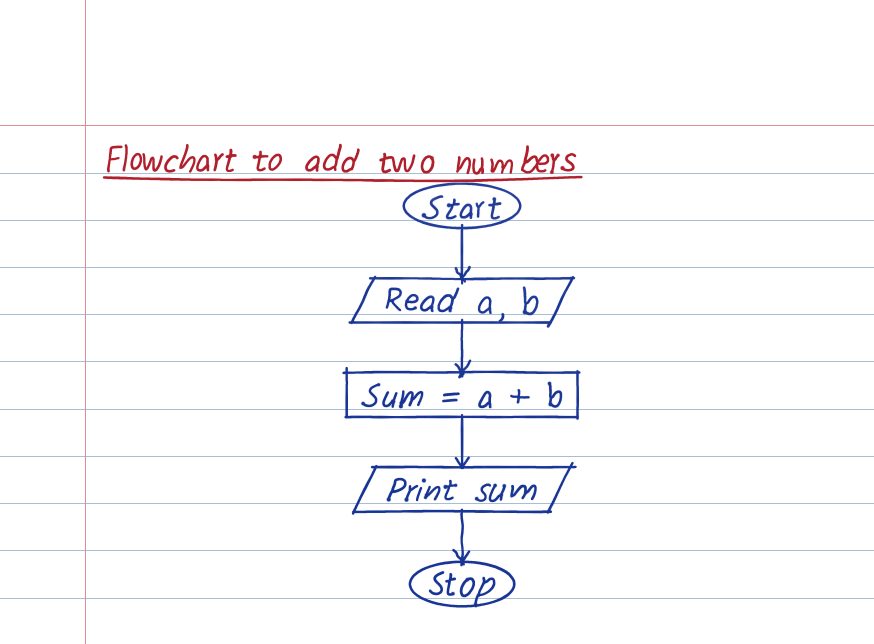
Already have an AI answer?
Paste it anyway. Handwriter tidies the usual AI formatting for you: **bold** and ### headings
become plain headings, LaTeX maths like $\frac{a}{b}$ and \sqrt{x} becomes a written
fraction and root, Greek letters such as \theta are written as θ, and emojis and links are dropped. The prompt
just gets you the neatest result, and adds diagrams and flowcharts the AI wouldn't otherwise give.
Tips
- A ruled page holds about 250 words. Ask for “about 2 pages” to get roughly 500.
- Ask for the answer “in points” when your teacher expects points, or “as a paragraph” when not.
- Read the answer before you print it. AI can be confidently wrong, and the work you submit is yours.